Landscaping

Click on this line to take a tour of our landscape.

This is the first time we have bought a house without having landscaping taken care of by the builder and included in the purchase price of the house, although we did do extensive landscaping on a house we had in Houston.

Here are some things to think about when starting to plan your landscape:

Grass lawns are not a requirement in HSV. If you want a low maintenance landscape, you can get the lot covered with mulch and rock for a few thousand dollars, including a few plants.

You can even buy plants and put them in yourself and save a lot of money. But before you buy the plants, you should try digging a hole first. The soil in most places in HSV is not made for planting.

We bought a couple of Bradford Pear trees before talking to a landscaper and tried planting them. We could not even get a shovel into the ground. The "topsoil" on our lot is made up of clay, rocks, and large tree roots. (When they clear a lot of trees, they don't take the roots out too!)

After we bought a pick and could not get IT into the ground, we eventually gave up and left the trees for the landscaper to plant using a small backhoe.

A neighbor who did his own yard bought all the plants and hired some youngsters to dig the holes for them. He didn't want grass, so he did not have the trouble and expense of hauling in top soil. Instead of buying truck loads of hardwood mulch, he raked up pine straw which is plentiful in this area.

If you have a large and/or sloping lot and/or want grass, the cost goes up quickly when you add retaining walls, flagstone paths and patios, sprinkler systems, and of course the more plants and larger plants and trees you get. We have heard of people spending over $200,000 on landscaping. We kept our budget pretty low.


Choosing A Landscaper

When we chose a builder for our house, I felt pretty confident. We got bids and checked the builders' past work. We pretty much knew just what we were getting for the money and the quality to expect.

We tried going through the same procedure with landscapers. We talked to about a half-dozen different ones, drove around and looked at their work, and got designs and bids from them.

In the end, our selection method was about as scientific as sticking pins in the yellow pages. We had to pick the plan we liked the most and hope for the best.

The problem is that unlike building a house, there are few or no standards for landscapers, so bids are almost completely meaningless for comparative purposes.

You may get identical bids for similar looking designs, but end up with different looking landscape jobs of vastly different quality. The only way different bids will be comparable is if you specify the same plan and the size and exact variety of every plant and boulder. Good luck on that.

The lowest bid we got was from Village Landscaping. The highest was from "Dirt Cheap". We told both of them the same thing about what we wanted, so one would expect the bids to be based on comparable work and materials. That turned out to be far from the case, although we didn't even realize it at the time.

We chose Dirt Cheap because Kay liked their landscape plan the best. Once the job was done, we realized that they were higher priced because their landscape architect had in mind a much more extensive job than did Village Landscaping.

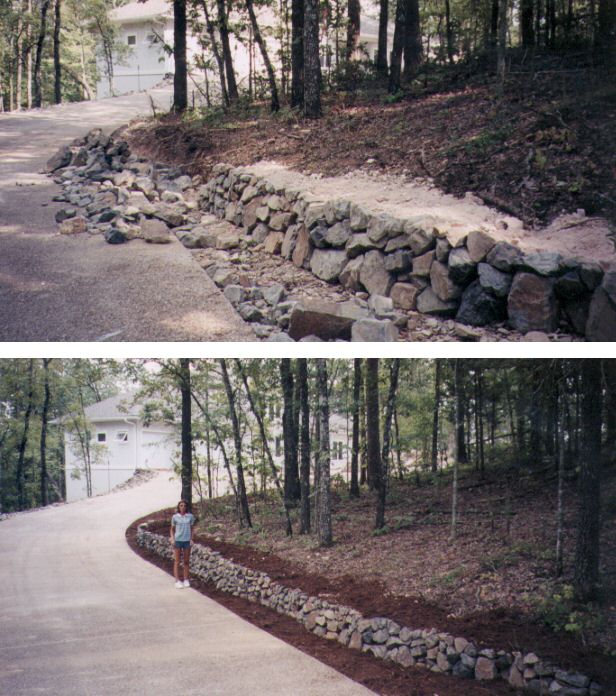
Village Landscaping's bid was based on a list of materials -- so much rock, so much top soil, so many plants. Dirt Cheap did quite a bit more rock work than Village Landscaping had planned, taking a couple of days to build a small retaining wall down our driveway for one, and creating a large, mounded rock garden for another.

Dirt Cheap also gave us two or three times more plants than Village Landscaping had budgeted.

Of course, if we had realized the differences in labor and materials up front, we could have gotten Village Landscaping to make a bid based on the large numbers, and they may have still been less than Dirt Cheap, but probably not by much.

We also talked to Casa Verde and some others, but the main reason we chose Dirt Cheap was that we liked their design best. We did not even talk to Bennett Brothers because they have a reputation of being very high priced and we were on a relatively modest budget, but BB does beautiful work.

An important thing to realize when talking to landscapers is that their work involves a lot of artistry. They don't really know exactly how they will do everything until they get in and start moving dirt, boulders, and plants around. This is the main reason that it is so difficult to compare landscapers' bids.

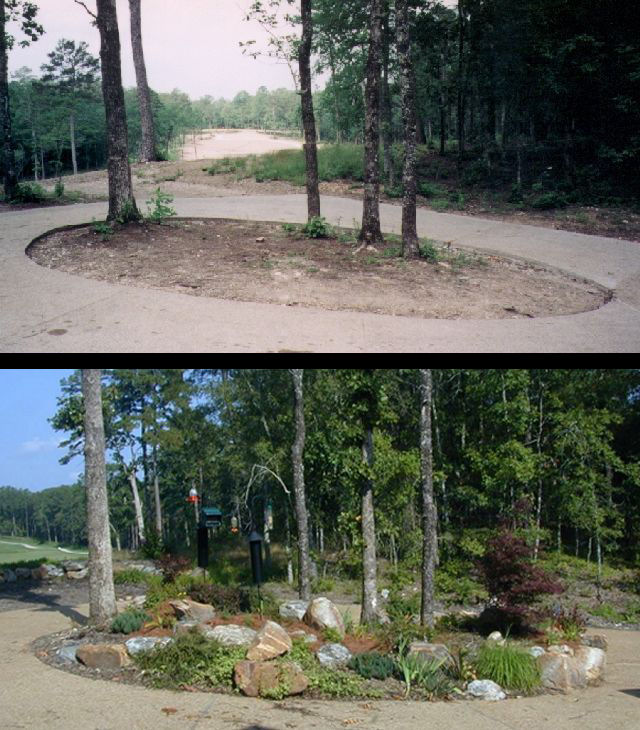
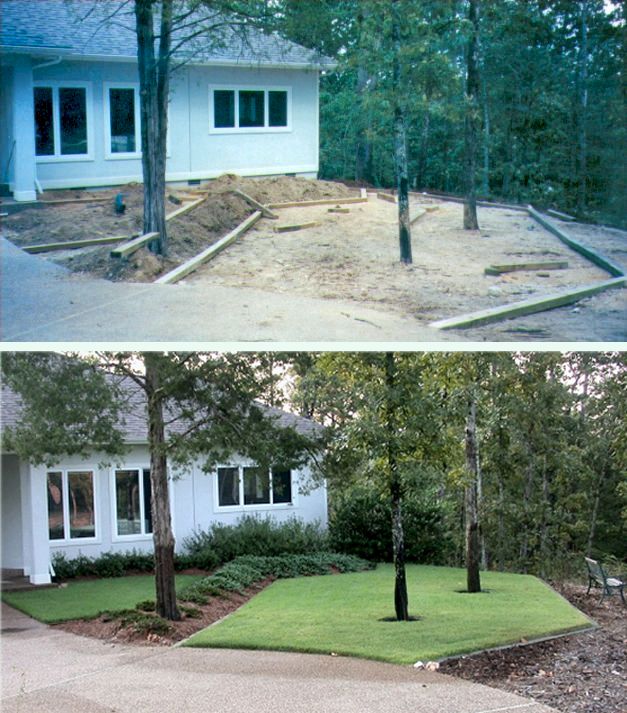
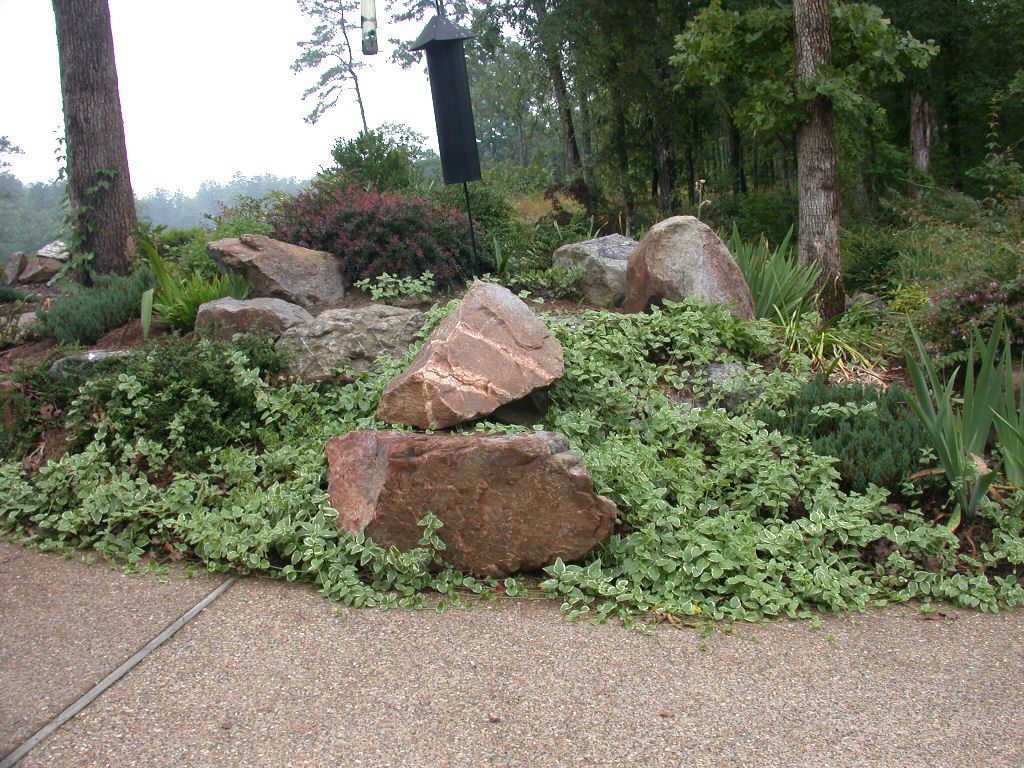
Dirt Cheap gave us the most detailed drawing, but even theirs was far short of really conveying what our yard would end up looking like. For example, our driveway circles around some trees in our front yard. Myron (the landscape architect) kept telling us that he was going to "mound up" the dirt in that area and make a "rock garden". We just couldn't picture it in our own minds, but Myron could, and this is now our favorite spot in the yard:

Before

After

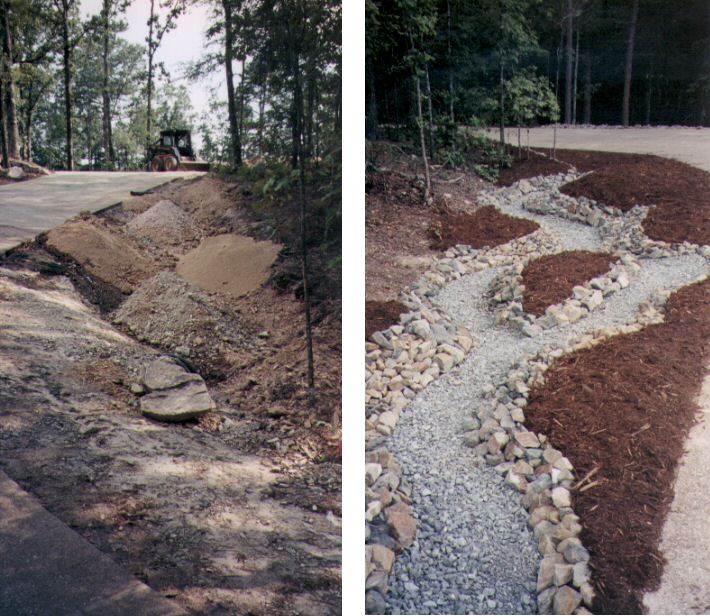
Another area that Myron talked about fixing up with rocks and which we could not picture was a drainage ditch on the other side of the driveway. Myron mounded up dirt on the sides and center of the ditch to make it look like a country creek. Then because not much water ever actually runs through that ditch, he covered the bottom of the "creek" with blue granite to give the impression of water:

Before:____After:

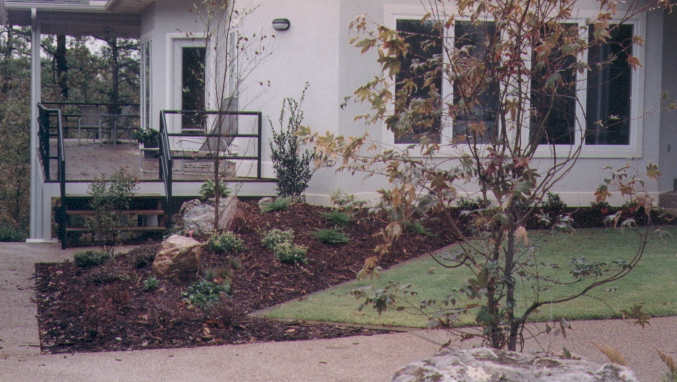
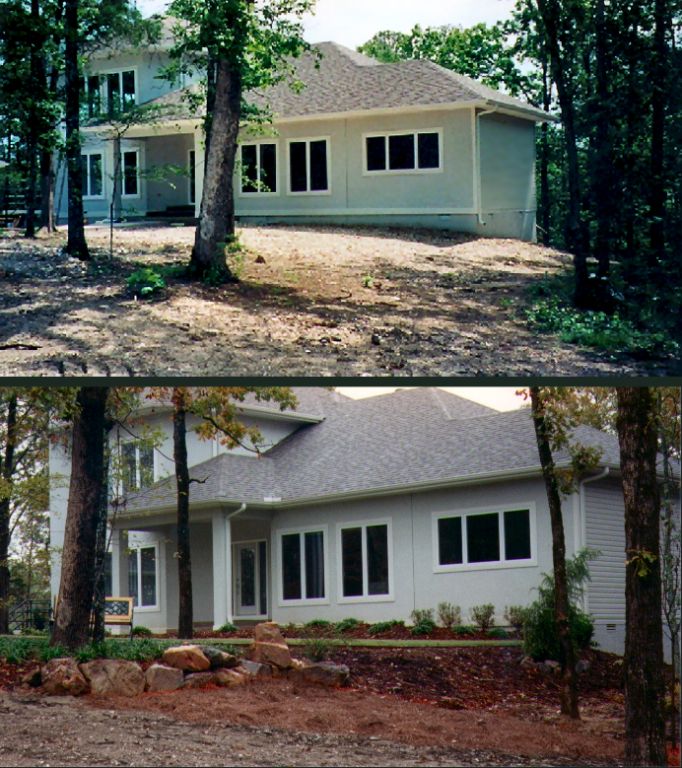
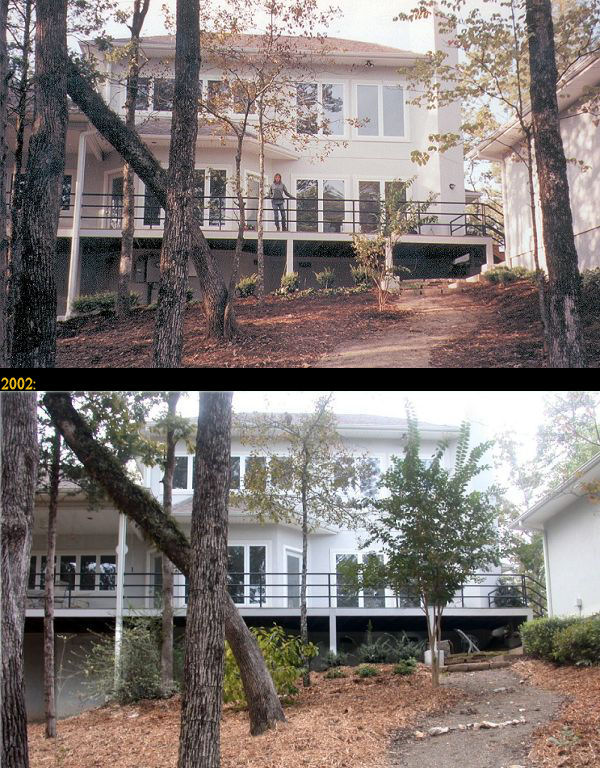
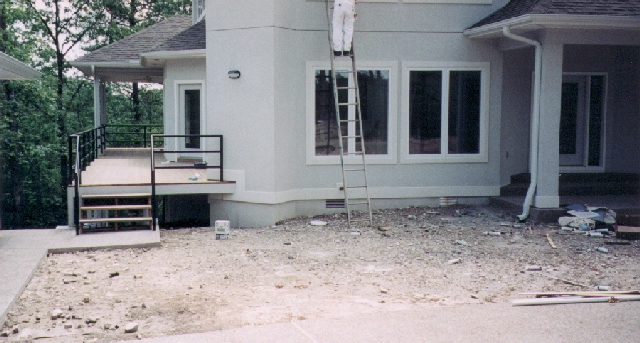
In front of the deck, Myron mounded up dirt around bolders to block the view under the deck from the front of the house:

Before...
1999:
2001:
2002:

The right front corner of the yard (facing the house) slopes down several feet, as can be seen in the "Before" picture below. Myron leveled up the area where the grass was growing so that people could see more of the grass from the driveway and front sidewalk. Having the lawn level also makes it easier to mow and trim.

From course:

From center:

The Elements Of Landscaping

Mulch --

You have to decide where you want mulch, what kind of mulch, and how thick you want it. Below are some different types of mulch, in order of increasing cost and lasting power. The Hardwood, Cedar and Cypress were all shredded wood.

  • Pine straw - free if you rake it up yourself, and there are a lot of pine trees around here; holds up well; lasts well.
  • Pine bark - bark may float downhill in a heavy rain. On level ground, it lasts well, but is not easy to walk on. Shredded wood is easier to walk on, but doesn't last as long (1-2 years). We redid the mulch near the golf course in 2009 and paid $22.50/yard with free delivery for 15 yards from Rock Bottom (on Hwy.5). We made a walking path through it with shredded Cedar.
  • Hardwood - $15/yard in 2002 from Rock Bottom.
  • Cedar - $19/yard in 2002 from Rock Bottom. About $25 in 2004.
  • Cypress - at times, hard to get in bulk. Wal-Mart sells it in bags.
  • Dyed wood - $30-$35/yard We have been told that this is wooden pallets which have been put through a shredder and then dyed either brown or (more commonly seen) red. Because this wood has been treated prior to being used for pallets, it lasts a lot longer than other types of mulch, but also costs a whole lot more.
  • Dyed shredded tires - about $90/yard. A lot of people in the neighborhood are using this because it supposedly will last forever. It looks good, too.

Regular shredded wood mulch will eventually (1-3 years, depending on type of mulch) erode away and have to be replenished, making it a maintenance item of sorts. An alternative is to cover the ground with plastic (to keep out weeds) and cover that with gravel. In theory, this makes the area maintenance free. In practice, the plastic tears and weeds come up through it anyway.

We specified mulch because we think it blends in better with all the woods around our house. In areas where houses are built closer together, creating a little more of an "urban" environment, the gravel looks fine. It is also safer to have close to houses because wood mulch is flammable. We used to have a pine straw covered path around the back of our house, but got nervous enough to replace it with gravel eventually.

3-Year Update (2002):

After three years, the original mulch was pretty much gone - decomposed or whatever. The pine straw was still holding up, except where a hard rain had created ruts in it recently. Of course, we put the pine straw on pretty thick...

We decided to put in the new mulch ourselves to save money. For example, an area in the back that Dirt Cheap wanted $700 to cover with mulch could be covered by about 7 yards of mulch easily. And that would be spreading it a lot thicker than Dirt Cheap did. At $20 a yard, that would be about $140.

We hired a bobcat and driver to carry the mulch to our back yard. The time he spent on that one area probably cost us about $30, so for a total of $170, we did what Dirt Cheap wanted $700 to do, and we used better mulch laid on much thicker.

This is not to bad-mouth Dirt Cheap. Any landscaper is going to charge comparable (or higher) amounts for things you could do for yourself, ummm, dirt cheap.

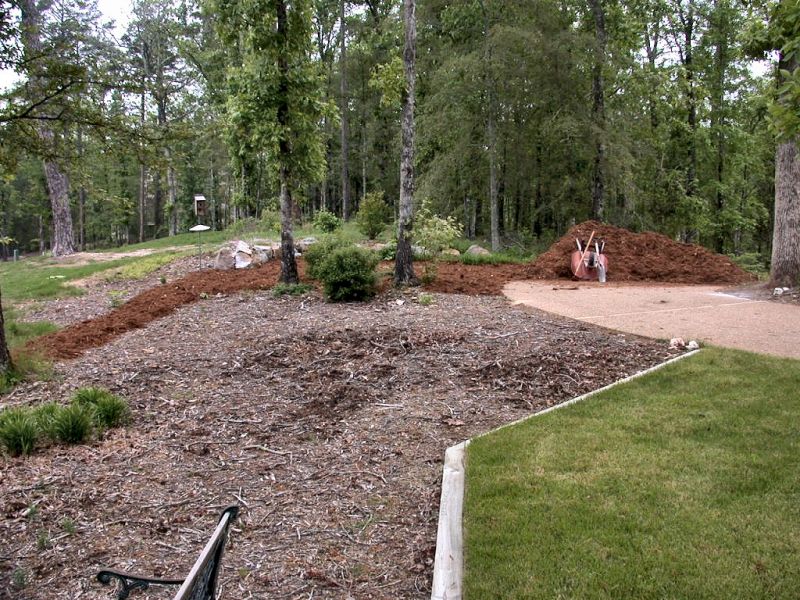
When we re-mulched the front areas, we had the truck drop the mulch right next to where we were going to spread it, and it still took us several days of back-breaking work to spread it a wheelbarrow at a time.

So when we got two more truck loads to go in the back, we hired a bobcat and driver to do the work. It took him three hours to carry two truck loads from the street 200+ feet to our back yard. Had we carried it a wheelbarrow at a time, it would have taken us weeks.

The bobcat driver spread the mulch around some as he dropped it, and I levelled it out with a hoe. Then rested while he went for the next load. This was much easier than using a wheelbarrow and well worth the $150 he charged.

As you can see, the cedar mulch (bottom) is a lot lighter than the original hardwood mulch (top). We expect it to darken up after awhile. One nice thing about the cedar -- it smells real good!

2004 and 2009:

In 2004, the shredded hardwood up front was getting pretty thin, so we put pine bark on top of it very thick. Five years later, it didn't look too bad, but weeds were starting to break through it pretty easily.

By 2009, the cedar mulch in the backyard was also pretty thin, so we hired a landscaper to redo it with pine bark mulch while doing some other landscaping around the yard.

We did not get him to do the front because we can do that ourselves relatively easily, so a few months later we got 10 backs of pine bark mulch from Wal-Mart at about $2.40 for a 2-cubic-foot bag (or $32.40/yard). It did not make much of a dent in the area, so I ordered a load from Rock Bottom, estimating that it would take about 15 yards, put down thick, at $22.50 a yard with free delivery.

Turns out that half that much would have been plenty, but the excess allowed us to put it down even thicker than planned. We should see no weeds coming up in that area anytime soon.


City Pit --

This is used to fill in areas, such as levelling up a yard. Then top soil is put over it for planting. The problem is that if you plant a tree or shrub, you will be planting it in 4"-6" of topsoil and the rest, city pit. We haven't found this to be a problem, since you can dig a big hole to put the plant/tree in and fill it with good soil, but if it concerns you, have your builder use more topsoil (at a greater cost, of course).

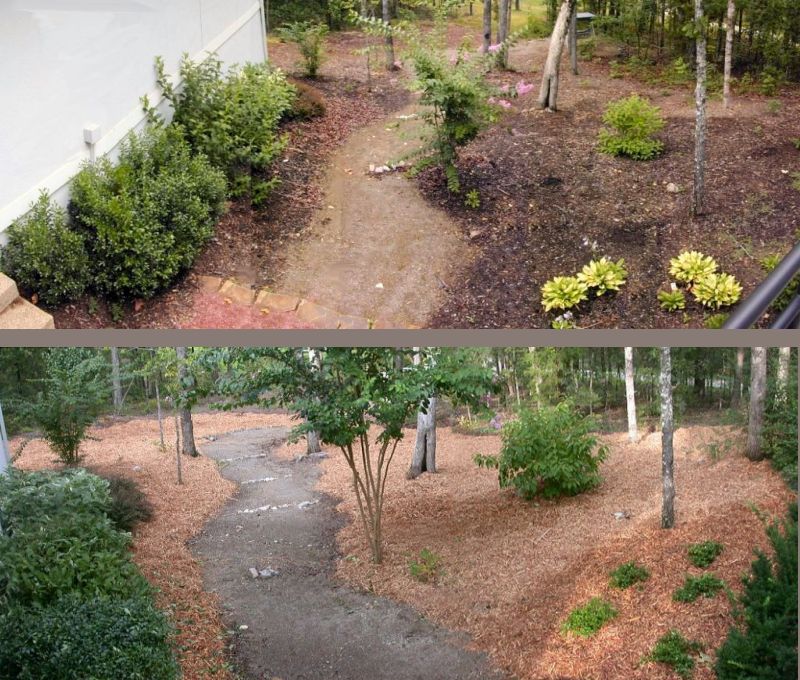
We had the landscapers put in a path going from our deck down to the bottom of our lot. It just consists of city pit. We had specified that the path be covered with brownish colored rock to provide stability. We were adament all along that we did not want gray gravel anywhere in the yard, opting for mulch instead of gravel.

One day we looked out the window and saw the workers covering the path with gray gravel. They said they could not get any brown gravel (which seems odd), but they agreed to scrape off the gray. That just left the brown city pit. We have been assured that it will harden and not wash away, but it hasn't hardened yet. We probably should have stuck by our guns and got it covered with brown gravel/rock.

Update: I have noticed in yards with gray gravel that it tends to turn a little more brownish from dirt and leaves blowing across it. Also, the surrounding mulch eventually changes from a dark brown to an almost grayish color. In addition, we have had problem with rain causing ruts in the city pit path. So the bottom line is that we should have let them put the gray gravel on the path.

On the two sides of the house which don't show and which have lots of trees and bushes close by, the builder had mounded up city pit around the foundation. Because nobody was going to see it, we didn't have anything else done to it, but the slope sides of the city pit have washed down. A retaining wall or rip-rap is really needed there, or at least some gravel on top to stop the rain from beating down on and washing away the city pit. Now it would be almost impossible to get a big load of stones or cement blocks back there to shore the sides of the city pit up.

Update: We finally broke down and got a landscaper to level up the paths around the back of the house, top it with gravel, and shore up the sides with rip-rap. Because our last landscaper is out of business, we had to get a different one. Read about the problems we had on our home page under "Service Companies (Not) Worth Hiring".

Rip-Rap --

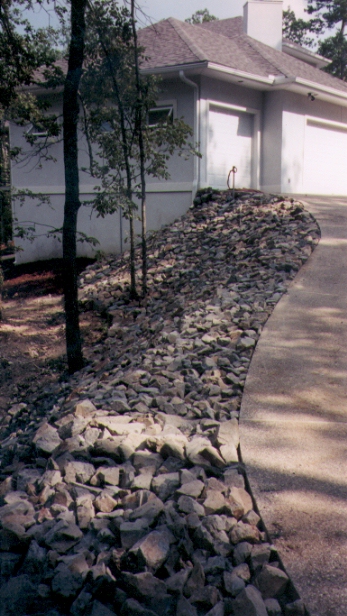
If your lot has any big slopes, they will probably require some additional work and expense. Our driveway, which is about 180' long, was built up quite a bit in some areas, resulting in a high, steep slope from the driveway to the ground.

To keep the dirt on the slope from washing out, the landscapers covered the sloping ground with plastic sheeting and covered that with large rocks (about 6" across on average). This is called "rip-rapping". The crew spent about three days just stacking these rocks, so of course this raises the cost.

Sprinkler System --

A sprinkler system will add at least $5000 to the cost of the landscaping. Since we have such a small patch of lawn, we opted not to get a sprinkler system.

We neglected to consider all the shrubs and flowers which also have to be watered. In retrospect, it might have been better in the long run to have gotten the sprinkler system than to have to be bothered with putting out sprinklers and hand watering the rest of our lives.

Our friends who built on Lake Balboa get an additional bonus of being able to pump water out of the lake for their sprinkler system.

UPDATE:

We got tired of all the hand watering. The grass didn't take much effort, just putting out the sprinklers, but hand-watering everything else took too much time, so we broke down and got a sprinkler system.

We got bids from four or five companies, and Dirt Cheap who did our landscaping gave us the best price. In fact, we got a better price than if we had gotten the sprinkler system at the time the landscaping was done, probably because we were getting separate bids for it.

Our friends who built the same time we did and who got a sprinkler system at the same time as their landscaping advised us to get a drip system rather than a spray system.

The advantages of the drip system are:

  • Less water is used. Spray systems not only lose a lot of water to evaporation, they spray a lot of water where it is not needed.
  • Water goes where it's needed. A spray head in the middle of a plant bed may be okay at first, but when the plants or bushes get bigger, they may block out the spray from other plants. A drip system has a separate drip outlet for each plant.
  • New drip outlets can easily be added. A spray system is divided into zones because only a certain number of spray heads can be on at once due to the need for sufficient water pressure to drive the heads. If a zone already has the maximum number of heads it will support, you cannot add more heads for new plantings without running another water line. A drip system does not require high water pressure, so you can easily add heads for new plantings.

Despite these apparent advantages, Dirt Cheap strongly recommended against any use of drip outlets. For one thing, drips cannot be used to water grass, of course, but Dirt Cheap also claims that the drip tubes have to be replaced regularly (every couple of years or so) and that they just do not work as well.

Other people who use some or all drip systems seemed pleased with them, but we decided to go with what Dirt Cheap recommended. Drip is cheap and relatively easy to install, so if need be, we could add it later.

By waiting a year before getting a sprinkler system, not only did we save money, but we were able to plan the system to include areas of the yard in which we did not originally plant. This is a significant advantage, unless you are absolutely determined that you are not going to add anything after the main landscaping job is done.

The drawback to waiting is all the time we wasted hand-watering, plus some damage was done to the grass and plants in burying the pipes which could have been avoided by doing the sprinkler system first.

One argument we had with the installers was the location of the control box. We wanted it in the garage where we could easily get to it and where it would be protected from the elements. The installers wanted it outside (easier to install, I guess) and claimed that it is element-proof.

We had one in Houston and the "element-proof" controller deteriorated being outside. When we had it replaced, that installer claimed it should have been put in the garage.

Element-proof or not, it is definitely more convenient in the garage, especially if it's pouring rain and you want to shut the sprinkler off.

Also, after having the controller lose its settings whenever the power blipped, we bought a battery backup for about $50. (Office Depot sells them for use with computers, but we lied!) We wouldn't have been able to add this outside.

Sprinkler System Update -- We have been very happy with the sprinkler system over the years. We've had virtually no problems with it. However, we recently (Aug. 2005) had a technician out to add some new spray heads and change some nozzles to different types to adapt to new areas of plantings we have done.

He also had to add extensions to some sprayers in or around shrubs to compensate for their growth. We also had him put in a rain sensor to keep the sprinkler from coming on when it has been raining.

One problem we have is that with all the new outlets, we barely have enough water pressure to drive them all. The tech said it would be too costly to add a new controller and valves to add more zones.

The original controller only allows up to four zones. Toro (the brand we have) has a 6-10 zone controller which costs only about $100. It also lets you program the controller with your computer. If I were putting in a system today, that is what I would get.


Grass --

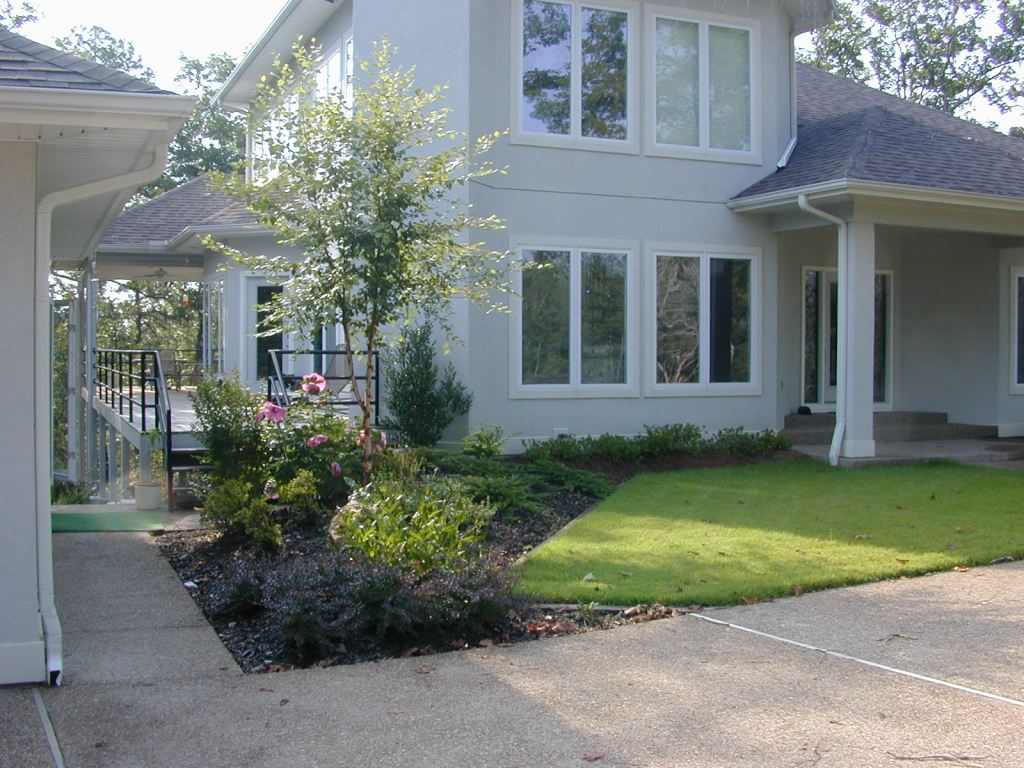
Again, you can easily get away without having a grass yard, and we had about decided not to have one, but Myron convinced us that a grass yard in front would look so much better that it would be worth the trouble and expense.

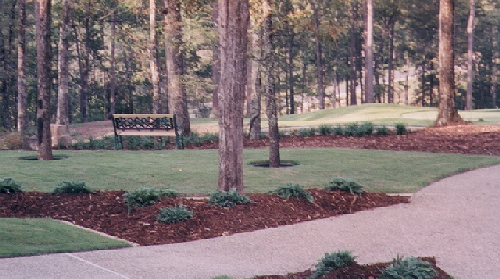
Also the grass in our yard blends visually with the grass on the golf course to make our yard look bigger. (The grass in the upper-right part of the picture is the 14th green.) If you decide to get grass -- sod costs more than sprigging, but gives you a yard faster. Most people here go with Zoysia grass.

Out "back" (the side which faces the 15th fairway's pond), our lot slopes down a long way with a lot of trees and undergrowth at the bottom, so we decided on a more natural looking landscape without grass.

The borders between grass and beds can be divided by simple plastic or metal edging strips, by bricks, or any number of things. We chose to use timbers buried so the tops are level with the ground. This make it easy to cut and trim the grass without anything sticking up. We also use it as a path to roll wheelbarrows down without having to go through the grass or heavy mulch.

Boulders --

Landscapers here like to use boulders, even though some people joke that selling rocks to people in Arkansas is like selling ice to Eskimos.

Most of the landscapers seem to just stick single boulders around the yard randomly, sitting on top of the ground so that there is no mistaking that they did not "grow" there.

We said that we did not want any boulders that didn't look like there were in the ground to start with, and that we preferred clumps of boulders rather than one sticking up every few feet.

We think that our landscaper did a great job of using boulders. Most of them are buried in the dirt rather than just being set down on top of it, and even those that sit on top look like they grew there.

Plants

Because the lots in our area are thick with hardwood trees, we still had an abundance of trees -- red oaks, white oaks, hickories, cedars -- even after knocking down the pines. As a result, we did not have to spend much on new trees, which is where a lot of money can go in a hurry.

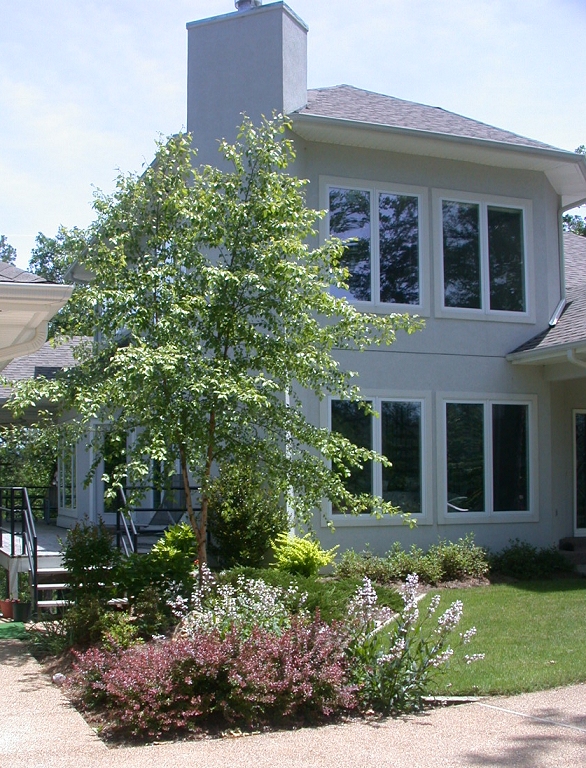
Even so, we did get a 10' (or so) River Birch, a 6' cedar, and a couple of Japanese Maples.

Although we had some ideas about what types of plants we do and do not like, we are not plant experts and were at the mercy of Myron to suggest plants.

Myron's biggest mistake was putting plants in direct sunlight which require full or, at most, partial shade. Examples: Hastas, Ferns, and, more expensively, a large Blue Cedar (which only lived two years) and two Japanese Maples, one of which died in three years. We have been told that the Blue Cedar didn't stand a chance in this environment.

We finally had to transplant the Ferns and Hastas to shadier areas. We replaced the Hastas with Gardenias and the Ferns with Dwarf Nandinas. Both Gardenias and Nandinas like the sun.

After all the planting was done, we bought about 250 bulbs -- bearded iris, narcissus, crocus, and daffodils -- and filled in some areas which we intentionally had the landscaper leave blank for us.

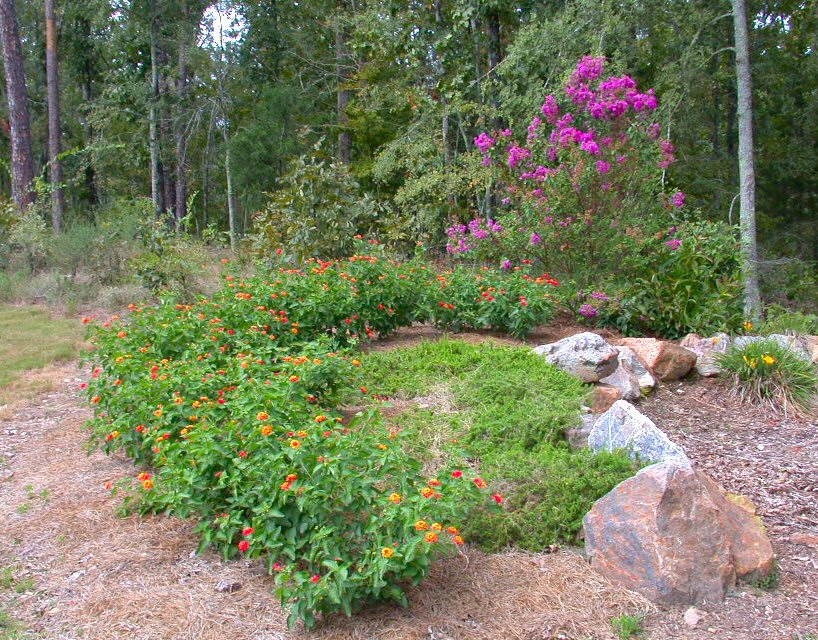
Update: Over the years, we have continued to purchase, transplant, or be given new plants. In 2003, we bought a flat of Lantana plants for $30. They have bright red and/or orange flowers which seem to last forever and have become our favorite plant. There was some question as to whether Lantana would survive the winter. So far, they have done fine, both for us and for others in the neighborhood.

Click on this line to take a virtual tour of our landscape.


Final Analysis

The biggest problem we had with Dirt Cheap was getting the plants we asked for. Before signing a contract, we took the landscape plan in hand, crossing out things we didn't want and writing in everything exactly as we wanted it (such as the brown gravel/rock on the path). Having learned our lesson from building a house, we wanted to make sure that all the details were in writing to avoid any misunderstandings later on.

The contract called for all the plants to be provided that were on the plan, but getting them was a fight throughout and we never did get everything we were supposed to.

For example, we had talked to Myron several times about our desire to have the variety of azaleas which bloom more than once a year. These are called Encore and/or Fashion azaleas. They are smaller azaleas which we wanted to go under our big windows in the front. Under our higher bedroom windows, we specified any variety of larger azalea.

When they brought all the plants out, there were 16 azaleas all of one type, which was a small azalea which blooms only once a year. After a little arguing, Myron finally got the correct azaleas.

The plan calls for "nandinas" (which we understood to be full-sized) in one area and "dwarf nandinas" in another place. Instead we got all dwarfs.

But the worst part was that when Myron said they were done, we were short about a third of the plants which were on the plan. Two large areas in the front of our lot were completely bare of plants which were on the plan.

Myron argued that they had spent all the money they had budgeted. We argued that this was not a cost-based contract -- they had agreed to supply all the plants on the plan for the contract price.

He finally agreed to supply a few more plants, still leaving us far short of what was on the contract. Since we were basically pleased with the overall job, we did not press it.

In the sections on building a house, I stressed how important it is to get details in writing if you didn't want to be stuck with something not done the way you wanted it. In landscaping, not only are you necessarily at the mercy of the landscaper's artistry for the final look of the job, but even getting details in writing may not help. (Read about our city pit path, above.)

Another problem we had was with the placement of some of the plants. Some things which do not do well in hot afternoon sun, such as ferns and Japanese Maples, were placed in unshaded areas and died.

If this sounds like a horror story -- well, it isn't really. As I said, we are quite happy with the completed job and feel like we got a good price overall. (Unfortunately, Dirt Cheap is no longer in business.)

Four-year update: When plants are being put in, they usually are much smaller than they will eventually grow to be. It may look funny the first year or two, but you must leave room for the plants to grow, especially in beds next to the house.

If you can't stand all the empty space around them for the first couple of years, you could fill it in with annuals until the plants reach their full size.

You can check the tags that come on the plants to see what their eventual height and width will be. If a plant is going to grow to 10' high, you probably do not want to put it in a place where it cannot be allowed to grow that high, such as under a tree.

Likewise, a plant that will get to be 4' wide should not be put in a bed which is only 2' deep. First of all, it will be lopsided if it starts only a foot from the house and forced to grow out. Secondly, if you have a yard, driveway, sidewalk, etc., adjoining the bed, you will constantly have to be cutting it back.

So save yourself a lot of work and grief in the long run by checking the specs for the plants and making sure the landscaper is giving them plenty of room to grow.

Keep the tags. Try to get the tags off all the plants and store them somewhere. If a plant/tree has no tag, ask the landscaper what it is and write it down. Don't be like us and find that years down the road, you have no idea what some of the plants are. We wasted a lot of time researching information we should have had from the outset.

Different plants often have different requirements for soil type, pH, watering, fertilization, pruning, etc., which is where having their tags comes in handy.