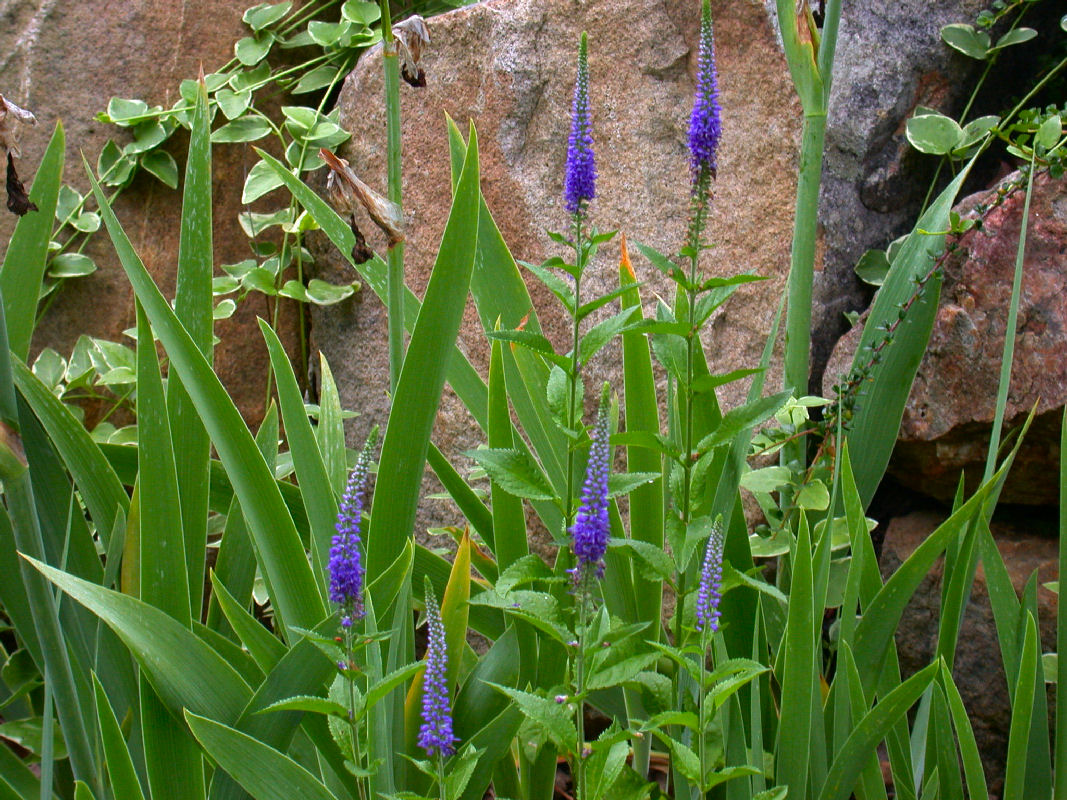
Plant Names and Requirments List
Web Links:
Click on the plant name for our page for the plant. Beyond that,
Web sources are usually given for data. If there is only one link
on a line (other than the name), the other data is normally from
the same link. If more than one link is on a line, data is from
different links. This chart is for established plants.
For planting requirements, click on the links.
Fertilizer:
From 1999 to 2009, we added virtually no fertilizer to our landscape
except on the lawn and we have had few problems, which is not to
say no problems, though not necessarily problems attributable to
lack of fertilizer.
Although the native soil is full of rocks and roots, this area has
always been very heavily wooded, so maybe the leaves and other forest
debris have kept the soil healthy. Still, if a source says that some
plant should be fertilized, that is shown in the chart, even though
the plant has done well for us without it. Many links say to fertilize
in the early Spring before new growth simply by adding a layer of
compost, and we are now doing that. Even compost on our lawn is enough to green it up.
Anti-Critter Defense:
Being surrounded by wild wooded areas, we get critters in our yard at night.
The most destructive are armadillos, which dig around looking for worms.
We wouldn't mind if they stayed in the mulch, but they go wherever the worms
are, which is usually in the enriched, well-turned soil around our plants.
And while they generally dig between plants, they are not beyond digging up
small plants and bulbs to get to whatever is nearby.
Armadillos are not repelled by the usual critter repellent chemicals, and they can be very hard to trap. We tried for a year and never trapped one despite using all the tips provided on the Internet.
As a last resort, we took to covering new beds with "chicken wire" from Lowes. This is actually stronger than real chicken wire and in 1" squares. We then cover the wire with mulch, dirt, or compost.
When planting bulbs or root stock which has no growth above ground, the plants will come up in the holes of the wire. You may have to keep an eye on them and use wire snips to enlarge the holes around the plants.
To cover plants above ground, you will have to cut out holes in the wire to fit the wire down over the plants. If they are too big for that, you will have to cut strips of wire to fit on either side of a plant and cut holes in the edges to fit around the main stem(s)/trunk(s).
The drawback is that if you ever want to take up plants or put in more plants in an aread which is covered by wire, it may be hard to get the wire out of the way.
|
|
Light and Soil:
We have to keep checking light requirements because light changes as
trees branch out or a tree or limb falls. "Full sun" is generally
more than 6 hours of direct sun. "Part shade" is generally 4-6 hours of
direct sun. If "part shade to full sun" is shown, plants usually do
better in full sun, though they may require more water. If no soil
requirement is shown, assume a pH of 5.5 to 7.5 is needed.
Timed photos show that we have no "full sun".
Watering:
Virtually every plant on this list has the same requirements regarding soil and water:
the soil must drain well but retain moisture, mulch to help retain moisture, and water
no more than 2-3 times a week for 20 minutes with a sprinkler system after established.
Many sources say to water once a week when there has been less than 1" rain for the
week, but some shallow-rooted plants need watering more often. Just watch for wilting.
"Sprinkler", in the chart, indicates that regular watering of some type is needed.
Water-logged soil is bad for these plants, even if the chart says to water freely.
Specs saying to water less than once a week, including "drought tolerant", is an outside
limit and normal watering, such as in the sprinkler system, will not harm these plants.
Drought tolerant plants must be watered at least until established, and while drought may not kill them, they may wilt until watered.
Anti-critterl, continued:
Click for enlargement.
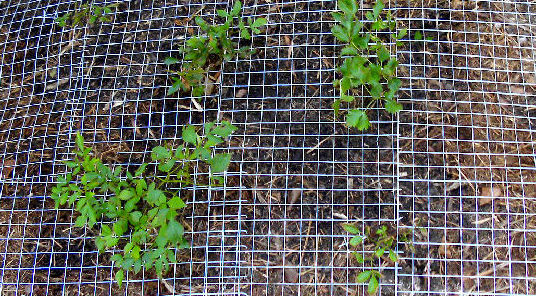
Irises are planted with the rhizomes half above ground and half below. The only way to use wire with them is to lay down the wire, cover it with an inch or so of topsoil, and plant the rhizomes on top with the roots going through the wire into the soil below.
Since irises must be taken up and divided every few years when they get too crowded, the wire is, again, going to make this a much more difficult job.
I wish there were a better alternative, but I can't think of one.
|
| PLANT NAME |
FERTILIZATION |
OTHER CARE & INFO |
POSSIBLE PROBLEMS |
LIGHT & SOIL |
BLOOM TIME |
WATER REQUIRED |
|
|
|
|
|
|
|
Abelia, Pink
Edward Goucher |
Spring, before new growth |
prune in Winter |
pest tolerant |
part shade to full sun |
Spring thru Fall |
2-3 weeks |
Ajuga reptans
"Bronze Beauty" |
Early Spring |
deadhead (we never do - too many)
Divide early summer. |
crown rot |
full shade to full sun |
April-May |
sprinkler |
Allium Fireworks
Allium schubertii |
compost any time;
use bulb fert. after flowering |
12-18" tall, 3-6" spread;
allow leaves to stay on |
|
part shade - full sun |
early summer |
water regularly |
| Allium Globemaster |
|
3' tall, 10+" spread |
|
part shade - full sun |
early summer |
moist soil |
| Anemone Pulsatilla vulgaris (Runuculus) |
monthly |
deadhead |
aphids, beetles, slugs |
part shade to full sun
Moist & well drained |
early to late spring |
1" water/rain per week |
| Arum Italicum |
|
plant 3" deep; grows 12"-14" tall |
poisonous - wear gloves |
part shade |
late spring - fall |
moist soil |
| Astilbe |
spring: light fert. or compost followed by a 2" layer of mulch |
divide every 3-4 years as new growth emerges in Spring |
|
shade |
late spring or early summer |
likes moist soil |
| Aucuba japonica 'Variegata' |
Spring, before new growth; monthly |
|
NOT deer resistant. Black leaves if roots covered with mulch. |
shade, part-shade |
Mar.-Apr if pollinated |
"water freely" or "once in a while" |
| Azalea (Rhododendron indicum) |
Bayers every 6 weeks |
no dead-heading needed;
prune after spring flowering |
|
full sun to part shade; less will not produce proper blooms |
various, see page |
sprinkler, but don't let ground dry out |
| Barberry, Crimson Pygmy |
Spring, before new growth |
|
|
Full sun |
|
moderate; prefers dry |
| Barberry, Golden |
Spring, before new growth |
|
|
part shade to full sun |
|
moderate; prefers dry |
Beardtongue
Penstemon digitalis |
|
deadhead for rebloom |
powdery mildew, rust, leaf spots, Southern blights; somewhat invasive, but easily pulled; deer-resistant |
part shade to full sun |
May through June |
drought tolerant, sprinkler is okay |
Begonia, Dragon Wing
|
balanced fertilizer while blooming |
bring in during winter
See this guide for begonia care. |
slugs |
full sun to full shade |
June - Oct. |
water during summer |
Black Cohosh
Actaea racemosa |
|
Keep soil moist. May need staking.
deer resis.; 4'-6' tall by 2'-3' wide |
|
shade - part sun
pH:5-6 (slightly acidic) |
June - Sept. |
medium - moist |
| Black-eyed Susan Rudbeckia hirta |
|
|
can be invasive |
shade to full sun |
May/June - Aug/Oct. |
drought tolerant |
White Blazing Star
Liatris spicata ‘Alba’
|
|
|
|
|
mid- to late-summer |
drought tolerant |
Blood Grass, Japanese
Imperata |
|
Remove brown blades after frost.
Cut back to 4"-6" in Spring. |
Invasive |
|
N/A |
requires moist soil |
| Bradford Pear |
normally, use no nitrogen |
prune after flowering |
large limbs/trunks can split off in high winds |
|
|
sprinkler |
Buckeye, Red
Aesculus Pavia |
once a year |
|
poisonous; no serious pests |
part shade to full sun |
April |
weekly is preferable; low drought tolerance is claimed here, though it does okay on its own in the wild during drought |
Butterfly Weed
Asclepias tuberosa |
none needed |
propagates from seed if not dead-headed;
cut back to 6" after bloom for rebloom
Height: 18-26". Spread 18-36" |
aphids, but read link |
part shade to full sun |
several weeks from mid to late summer |
drought tolerant |
| Camellia |
fertilize sparingly or March and July |
prune in Spring |
|
|
|
once a week |
| Candy Lily |
|
|
no serious problems |
part shade to full sun |
|
|
| Canna Lily |
|
Cut down to ground and top with compost at end of year in zones 8+. Zones 7- dig up and divide. Deadhead & cut stems to ground after bloom. |
Slugs, snails, spider mites, and caterpillars may be problems.
Rust, fungal leaf spot, and bacterial blight are common.
Bean yellow mosaic and tomato spotted wilt viruses can occur. |
full sun (6+ hours) |
summer, fall |
water 1" per week. |
| Cedar tree |
|
|
|
|
|
|
| Chrysanthemums |
every 7-10 days from midsummer until buds begin to show color |
pinch off tops when 6"-8" tall for bushy plants, earlier flowering |
|
full sun |
mid-summer to early winter |
|
| Clematis |
after buds are 2" feed every 2-4 weeks except when in full bloom. And use 0-20-0. |
4" of mulch to keep roots cool or provide other protection |
|
part shade to full sun |
early to late spring, depending on winter temperatures. |
sprinkler |
Cobra Lily
Arisaema candissimum |
|
|
|
|
|
keep watered |
Columbine
Aquilegia 'McKana' |
water soluble fertilizer monthly |
Height=30". Deer/rabbit resistant.
Self-sowing plants bloom 2nd year.
Deadhead for more blooms |
Keep soil moist until well established. |
full sun to
mostly shade |
mid-spring to
early summer |
moist soil |
Columbine
Aquilegia 'Dorothy Rose' |
once-twice a year |
propagate by seed,
not by division |
leaf miners,
(rabbit resistant) |
part shade to full sun |
|
|
| Columbine, Mixed |
use slow-release granular in Spring; can also use liquid fertilizer every 20-25 days |
|
pre-treat with fungicide in spring, with insecticide at end of Winter |
part shade to full sun |
|
every 1-2 weeks |
Coneflower
Echinacea purpurea 'Double Decker' |
|
|
|
full sun |
|
|
| Cotoneaster |
every 2 weeks until flowering, then monthly |
|
|
part to full sun |
|
|
| Crape Myrtle |
little/none needed; over-fert. can reduce cold hardiness |
cutting back ("Crapemurder") not recommended; deadhead to promote more blooming |
aphids and some diseases are possible, but not prevalent |
full sun for full flowering |
mid-Summer, 70-100 days |
drought tolerant, but heavily water once in Spring and once in Fall |
| Crested Iris |
|
do not cover top of rhizome |
|
shade to full sun |
Spring |
dry to moderately moist soil; consistently moist if in full sun |
Crown Imperial
Fritillaria imperialis |
|
Plant 8" deep on their side on 2" of sand. After flowering stops and the leaves die off in mid summer, cut the stems back to just above the ground level, then mark the spot with a stake. Provide a heavy winter mulch, which should be removed and replaced with a top-dressing of compost in the spring.
|
|
full to part sun |
mid-spring |
Water regularly during growing season; stop when it goes dormant. |
| Cyclamen |
|
|
|
|
mid- to late-summer |
|
| PLANT NAME |
FERTILIZATION |
OTHER CARE |
POSSIBLE PROBLEMS |
LIGHT & SOIL |
BLOOM TIME |
WATER REQUIRED |
| Daffodils |
if at all: 5-10-5 in early Fall and very early Spring; top-dress with compost once/twice a year |
do NOT cut back nor braid the foliage (but flower stalks can be cut back); mulch 3" after several hard freezes; lift and divide bulbs every 5-10 years in early Summer; alternate years: remove flowers after they wilt for bigger flowers next year or leave for seeds; plant in Oct.-Nov. |
|
part shade to full sun |
early Spring |
|
Daisy, Banana Cream
Leucanthemum superbum |
|
deadhead |
|
partial shade - full sun |
all summer |
water |
| Daylilies |
use low nitrogen (5-10-15 or 6-12-12) fertilizer in Spring and mid-Summer |
compost-mulch in the Spring;
deadhead for reblooming;
when no more buds on a stalk, cut the flower stalk to the ground;
remove dead foliage in Fall;
division is not essential |
Yellow leaves are not a sign of sickness; the yellow part can be left on or cut off, but don't cut off if any green is left. |
part shade to full sun; soil: 6.0-6.5 pH |
late Spring to Autumn |
drought resistant, but you will get better flowering if watered |
| Dogwood |
|
2" of pine needles or bark mulch |
Read about diseases |
part shade is better |
early Spring, 2-4 weeks |
once a week to depth of 6" |
| Easter Lily |
as Winter approaches, feed 10-10-10 fertilizer, add few inches of mulch and remove in the Spring |
As plant begins to die back, cut the stems to the ground for new growth/blooms |
|
|
June or July for a couple of weeks; may rebloom in September |
|
| Elaeagnus |
|
|
|
|
|
|
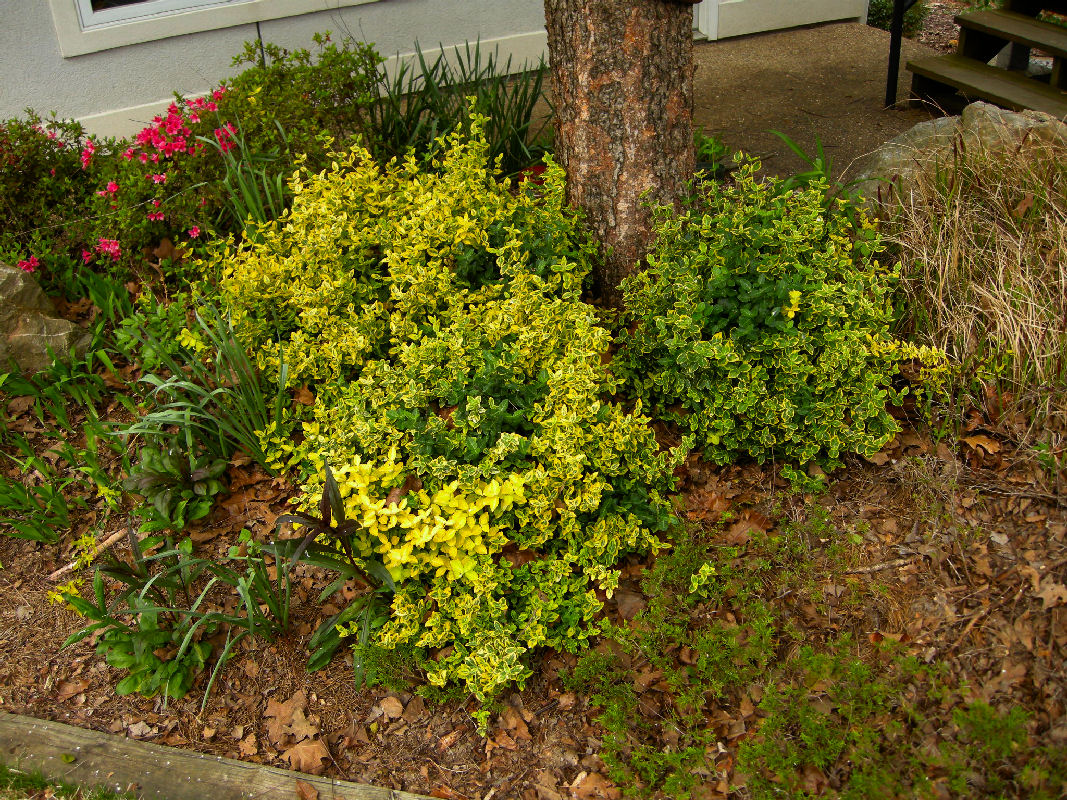
Emerald 'n' Gold Euonymus
Euonymus fortunei |
|
prune solid green shoots; we have had this since 1999, in the sprinkler system, but no fertilizing |
scale infestations;
can be invasive, climbing nearby trees |
shade to full sun |
|
|
| Euphorbia polychroma Sonnegold (Cushion spurge) |
|
|
nematodes, spider mites, aphids, mealybugs, fungal & bacterial diseases |
part shade to full sun |
April to mid-summer |
dry soil preferred |
Fern, Male
Dryopteris complexa |
|
Height=4-5'. Deer resistant. |
|
half to full shade |
|
drought tolerant |
| Ferns |
during growing season, once a month with a high-nitrogen fertilizer |
|
a variety of insects like aphids are possible, but we've had no problems; deer-resistant |
shade |
|
sprinkler |
| Fountain Grass |
in Spring before new growth or same schedule as your yard's grass |
cut back in early Spring to within 6"-10" of the ground |
|
light shade to full sun |
|
drought tolerant |
Foxglove
Digitalis |
thin layer of compost each spring followed by a 2"-layer of mulch |
NOT perennials, so leave last flower stalks to self-sow seeds. I've had no luck with them and will not replant. |
crown rot if not well drained |
part shade to full sun |
midsummer |
sprinkler |
| French Mulberry or American Beauty Berry (Callicarpa americana) |
none needed, but you can apply 10-20-20 at 4-month intervals |
|
|
full shade to full sun |
|
drought tolerant |
| Gaillardia (G. x grandiflora 'Goblin') |
water-soluble, quick release every 2 weeks during the growing season |
a short-lived perennial, so let flower stalks go to seed to get it to come back. I've had no luck and will not replant. |
powdery mildew |
full sun |
early Summer to early Fall |
dry to normal |
| Glads (Gladiolus 'Nanus Mix') |
When spikes show in the leaf sheath, feed with liquid fertilizer |
2"-4" mulch to retain moisture and control weeds; deadhead spent blooms, cut back stalks when flowers are gone, leave foliage for next year. I got ZERO blooms. |
apply insecticide when plants are 10" high |
full sun |
|
sprinkler |
Goat's Beard
aruncus dioicus |
|
Divide in early spring or fall.
3'-6' by 3'-6' |
fly larvae, tarnished plant bugs |
part to full shade |
spring, summer |
consistently moist soil |
| Helleborus |
organic mulch or bone meal in the Fall. Add slow-release fertilizer and compost to hole when planting. pH should be 7.0. |
Cut old flower stems as far back as possible. Dividing plants is not necessary as hellebore roots should not be disturbed. |
black spot; remove diseased foliage |
part shade |
Winter and very early Spring |
somewhat drought tolerant, but light moisture is best. Must be well drained. Planting under mature trees helps prevent water-logging. |
| Hibiscus |
every 2 weeks |
in the Fall |
aphids, ants, spider mites, mealy bugs, white fly; spray every 5-7 days (never Malathion) |
part shade to full sun |
|
|
Hyacinth, Blue Grape
Muscari armeniacum
|
add compost annually |
dig up and separate bulbs after a couple of years. After leaves die, prune them at the base. |
According to the University of Missouri, "Flowering often decreases in quality after the first year, and bulbs may need to be replaced every couple of years." |
full shade to full sun |
spring |
|
Hydrangea
Hydrangea macrophylla |
a 10-10-10 in May and July, 2-3 cups for a large plant, spread around drip line |
(1) how to change colors;
(2) prune in Summer after flowers fade. Blooms on old growth.
Also see: More Hydrangea info. |
|
morning sun, afternoon shade |
|
water often |
Inkberry
Ilex glabra |
apply a layer of compost in Spring and 2" layer of mulch |
prune in late Winter or early Spring |
|
part shade to full sun |
|
sprinkler |
| Irises |
5-10-5 lightly dusted around and between plants in early Spring and very late Fall. Add Bone Meal when planting. |
remove only limp, brown, or diseased leaves; keep garden litter away from the rhizome, especially during Winter; cut bloom stalks (not leaves) close to ground after blooming; |
divide every 2-3 years and inspect for borers and soft rot |
part shade to full sun; slightly acidic soil |
varies with variety; ours start in March, end in May |
okay in our sprinkler, but established plants do not require watering |
Dutch Iris
Iris hollandica |
|
Plant 4" deep, 3" apart,
prune yellow foilage in the fall |
|
full sun |
late spring to early summer |
water during growing season |
| Japanese Maple |
apply compost mulch around trees early in the Spring (or balanced fertilizer) |
Prune for shape in the fall |
|
morning sun, afternoon shade |
|
sprinkler |
| Juniper |
9-15-13 in early April before new growth |
|
|
full sun; 5.6-7.5 pH soil |
|
drought tolerant; overwatering causes root rot |
| PLANT NAME |
FERTILIZATION |
OTHER CARE |
POSSIBLE PROBLEMS |
LIGHT & SOIL |
BLOOM TIME |
WATER REQUIRED |
| Knockout Rose |
sprinkle time-released rose fert. in Spring after pruning |
cut in early Spring to 12"-18";
deadheading not needed |
|
full sun |
every 5-6 weeks |
|
Lantana
Verbenaceae |
none or water-soluble 10-10-10 and/or organic mulch in early Spring |
cut back to 12" in January and
apply 3" of pine straw mulch |
|
full sun |
blooms Summer through Fall |
drought tolerant |
Leucothoe
Leucothoe axillaris |
early Spring if growth wanted |
|
|
full shade to partial sun; acidic soil |
May |
sprinkler |
| Ligustrum, Wax-Leaf |
monthly with water-soluble fertilizer diluted by half; (we have never fertilized) |
|
|
best in full sun |
|
drought tolerant but prefers moist soil |
| Lily, Olina Tango |
|
|
|
|
|
|
| Lily Tree, Robina |
use slow-release fertilizer |
|
|
part shade to full sun |
|
sprinkler |
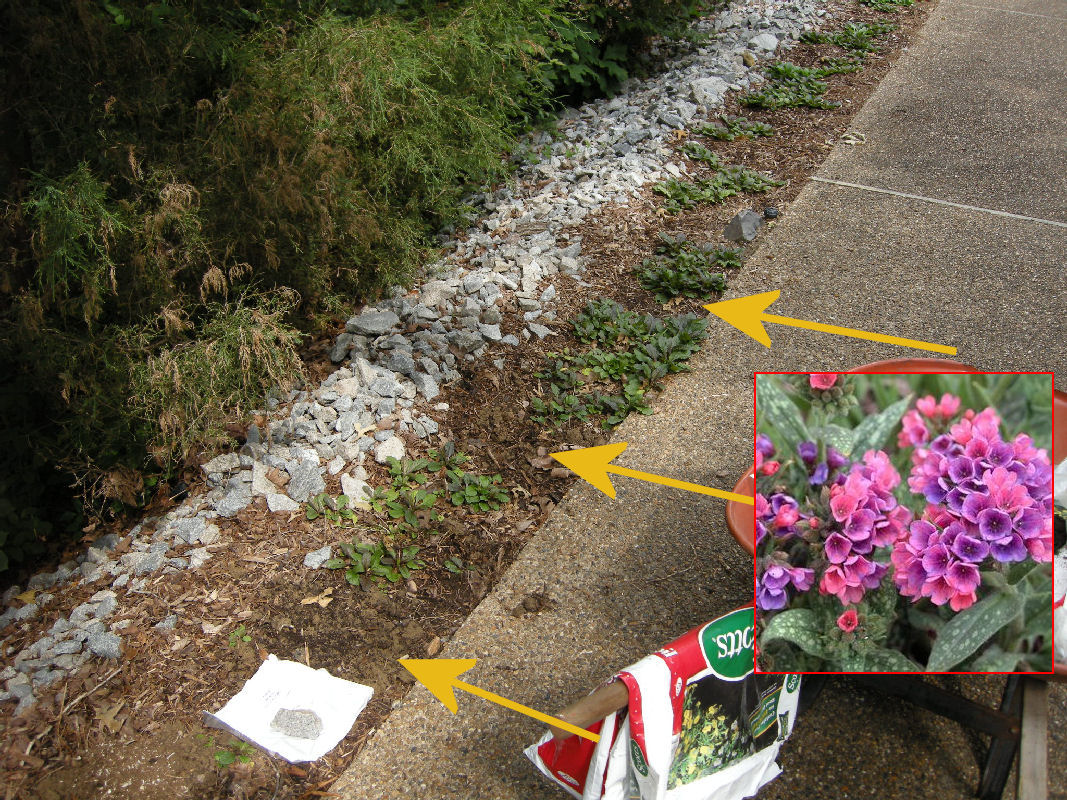
Lungwort
Pulmonaria |
small amount of 10-10-10 in early Spring |
shear back after flowering;
mulch for Winter protection |
Didn't come back. Planted Hellebores in its place. |
part shade |
late May |
sprinkler |
Mahonia aquifolium
|
|
soak roots 20 min. before planting |
can be invasive, but half of mine died. |
shade, part shade, sun |
Nov-March,
berries follow |
moist or dry soil |
Mediterranean Pinks
Saponaria ocymoides |
|
|
|
|
|
|
Mimosa
Albizzia julibrissin |
early Spring before new growth |
|
short-lived; wood is brittle; messy, dropping blooms, leaves, seed pods; wilt disease is a problem |
full sun for best flowering |
|
drought tolerant |
| Monarda, Jacob Cline |
|
|
|
|
|
|
| Mountain Bells mix |
planted 50 in a well prepared bed, got 1-2 blooms. |
|
|
|
spring |
|
| Mulberry tree |
|
|
|
part shade to full sun |
|
drought tolerant |
| Nandina |
|
|
reputation as invasive, but not in our yard |
part shade to full sun |
|
drought tolerant |
| Ox-Eye Daisy |
|
|
|
|
|
drought tolerant |
| Passion Flower |
use ratio like 2-1-3 |
|
shallow rooted - keep mulched |
part shade to full sun |
|
sprinkler |
| Pink/White Bleeding Heart (NOT the vine) Dicentra spectabilis |
thin layer of compost in Spring with 2" mulch on top |
after first killing frost, cut back to 1"-2" |
|
part shade; 5.6-7.5 pH |
Spring, and may rebloom |
sprinkler |
| Polemonium, a.k.a: Jacob's Ladder |
|
cut back after summer flowering for possible autumn flowering |
|
part to full shade |
Spring/early Summer |
sprinkler |
| Poppy, Oriental mix |
Well-drained soil with slow-release fertilizer in spring or compost. Cover crown of bareroot plants with 3" of humus-enriched soil. |
Got a little growth at first, but no flowers. Others complained of the same. |
|
full (8 hours) sun |
Spring, dormant in Summer |
1"/week when flowering, little when dormant |
Primrose
Primula vulgaris |
|
Height=10". Cut back to 1/2 after blooming for reblooms |
|
mostly sunny to
mostly shady |
mid-spring to late spring |
moist soil |
| Primrose |
planted in an isolated area in 2010 because of invasiveness, and it didn't come back! |
|
invasive |
shade to full sun |
|
sprinkler |
Purple Wintercreeper
Euonymus fortunei |
(We pulled this up after learning how invasive it is.) |
|
very invasive |
full shade to full sun |
flowers in early Summer, fruits in Fall, evergreen vine |
|
| Pyracantha |
|
|
|
shade to full sun |
|
sprinkler |
Quince
Chaenomeles speciosa |
organic mulch in mid-Spring and high potash fertilizer in late winter, plus a high-nitrogen fertilizer every 3-4 years |
|
|
part shade to full sun; 4.0-6.5 pH |
early Spring |
sprinkler |
Ranunculus asiaticus
(buttercups) |
12-4-8 early and late spring |
Deadhead. Remove dead leaves at end of summer. Mulch 10/31 & remove 04/15. |
|
8+ hours sun.
Well-draining soil, |
|
water sparingly |
Red Baneberry
Actaea rubra |
|
1'-2' |
Deer resistant |
shade to part sun |
white flowers in spring; red berries in fall |
sprinkler |
Redbud
Cercis canadensis |
fertilize in Fall if indicated by soil testing |
|
canker fungi if tree is under stress and has an open wound; insects in our yard like to chew the leaves |
part shade to full sun |
blooms in Spring |
drought tolerant |
Red-Tip Photinia
Photinia fraseri |
|
pruning for air flow around branches is crucial; prune in late Spring; we have never pruned ours and have had no problems |
remove diseased leaves from around tree |
part shade to full sun |
|
sprinkler |
| River Birch |
fertilize ONLY if indicated by soil testing |
do NOT prune between May 1 and August 1, which is when birch borers attack |
|
full sun, but cool, moist soil |
|
sprinkler |
| PLANT NAME |
FERTILIZATION |
OTHER CARE |
POSSIBLE PROBLEMS |
LIGHT & SOIL |
BLOOM TIME |
WATER REQUIRED |
| Scabiosa |
light application of organic fertilizer in early Spring and cut back old foliage to 3" |
cut back old flowers to base of stem for more blooms; divide every 3 years in early Spring |
|
full sun (but we have it in part shade);
Soil: 7-8.5 pH |
early Summer to mid-Fall |
sprinkler |
Sedum, October Daphne
Sedum sieboldii |
|
|
|
part shade to full sun |
late summer/early fall |
very drought tolerant |
Self-Heal/Heal-All
Prunella vulgaris |
a wildflower - it needs little or no care |
|
|
part shade to full sun |
May to September |
|
Snowdrops
Galanthus woronowii |
|
plant 3" deep;
propogates by self-seeding and bulb offsets |
deer resistant |
sun-dappled shade |
very early spring |
moist, humus-rich soil |
Spider Lily
Lycoris radiata |
|
deadhead as blooms fade;
divide every 4-5 years |
|
part shade to full sun; 7.6-7.8 pH |
late Summer to early Fall |
sprinkler |
Spiderworts
Tradescantia 'Blushing Bride' |
April & July |
Cut to the ground for hard freezes. |
|
full sun |
|
Needs lots of water |
| Spirea |
|
deadhead |
|
|
|
sprinkler |
| Strawberry Tree(?) |
|
|
|
|
berry clusters turn red in Fall |
sprinkler |
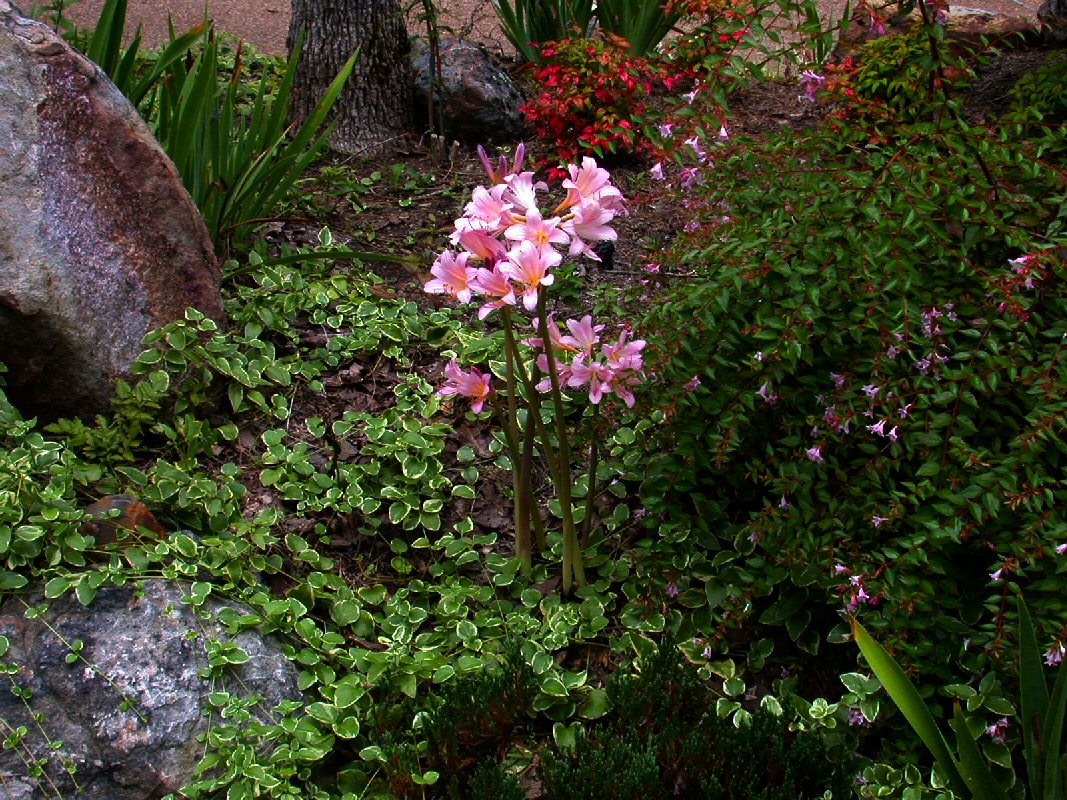
Surprise Lilies
Lycoris squamigera |
after the blooms fade and in early Spring |
divide every 3-5 years |
|
part shade to full sun |
blooms after July 4th for 4-6 days |
|
| Magic Carpet Thyme |
|
|
|
full sun |
all summer |
sprinkler |
| Tiger Lily |
once/twice monthly |
|
not deer resis. |
full to partial sun |
summer |
somewhat drought tolerant |
Toad Lily
Tricyrtis |
|
|
|
part shade; 4.5-6.5 pH |
mid-summer to early autumn |
Don't allow soil to dry out. |
| Tulips |
|
|
|
|
|
|
| Verbena - Vervain |
|
|
|
part shade to full sun |
|
drought tolerant |
| Veronica |
apply thin compost in Spring |
divide every 3-4 years |
Didn't come back after 8-9 years. |
full sun |
|
sprinkler |
Virginia Bluebells
Mertensia virginica |
|
|
dies down after blooming; needs other plants to take over |
|
spring |
|
| Red Prince Weigela |
April 1, May 20, July 4, Aug.15, Oct.30 (We have never fertilized.) |
we have never fertilized |
we prune for size |
part shade to full sun; 6.8-7.7 pH |
May-June |
sprinkler |
Widow's Tears
tradescantia virginiana |
minimal |
cut to ground in late fall or early spring |
resistant to most insects and diseases |
full sun to full shade;
thrives in poor soil |
late spring to early fall |
minimal |
Yarrow, Pineapple Mango Achillea millefolium
Tutti Frutti Series (tm) |
none needed |
Height=20+". Leave room to spread.
Deadhead for reblooms.
Divide every 4-5 years.
Deer resistant
|
Can be invasive.
Treat powdery mildew or botrytis mold with with fungicide
May get spittlebugs. |
full sun |
summer to early fall |
water only during severe drought |
| Densiformis Yew |
|
|
|
shade to full sun |
|
sprinkler |
| Zoysia Grass (If this link does not work, click here for backup page.) |
The name link in the first column is to a complete annual maintenance schedule. |
|
June 2009 analysis: P above optimum, K below optimum. Treatment: apply 2 lb urea or 3 lb 34-0-0 or 3.5 lb 27-0-0 plus 2 lb muriate of potash (0-0-60) (or any fert. w/1-0-1 ratio) per 1000 sq.ft. in May and July. |
shade to full sun |
|
sprinkler |
| _________________ |
________________ |
__________________ |
__________________ |
_______________ |
_________________ |
_________________ |
Bulb Care:
Bulbs need 6 weeks of growth after the last flower, then they can be cut back.
Fertilize with balanced (complete) fertilizer after first bulb shows.
(I have condensed the following for my own use from
http://pubs.ext.vt.edu/426/426-203/426-203.html.
Also see the "Plant Care" section on this page:
http://www.backyardgardener.com/plantname/pd_ef1f.html)
Soil Preparation:
Few perennials survive more than one year if the soil is not
properly prepared. Preparation is best done in the Fall.
First, have the soil tested. The results will indicate how much
fertilizer needs to be added in the Spring, and the pH level - which
should be adjusted if needed.
Check and adjust drainage: Dig a hole about 10 inches deep and fill
with water. The next day, fill with water again and see how long it
remains (should not exceed 8 hours). If drainage is poor, plan to
plant in raised beds.
Dig the bed. Add 4 to 6 inches organic matter ("OM") to heavy clay
to improve soil texture. Dig to a depth of 12 or 18 inches and leave
"rough" in fall or early spring. (Note: 2 to 3" of OM should be
applied if bed can only be turned 6 to 8" deep.) Finally, in spring,
add fertilizer, spade again, and rake the surface smooth.
Planting Times
In the Spring for late-Summer or Fall flowering perennials.
In Late Summer or early Fall for Spring-flowering perennials.
Plants like Ranunculus should be planted after the risk of last frost.
In HSV, this is April 15th. First frost is October 31st, on average.
Watering
Watering with sprinklers wets the flowers and foliage, making
them susceptible to diseases; use a soaker hose or drip system.
Mulching
Be careful not to pile mulch heavily over crowns during the Winter,
as this encourages rotting.
Apply mulch around plants only after the soil temperature has
decreased after several killing frosts. If Winter mulch is applied
too early, the warmth may cause new growth to start. Remove Winter
mulch as soon as growth starts in the Spring.
Fertilizing
Use 5-10-5 fertilizer spread in small rings around each plant in March 1,
April 15, and June 1. For late-bloomers, repeat August 15.
Water after fertilizing with granules to wash them off the plants.
Deadheading
Remove spent flowers.
Cut flower stems down to a healthy leaf if more buds, else to the ground.
Progagation
After 3 years, perennials are likely to be overcrowded and need
soil amendments. To divide mature clums, select only vigorous
side shoots from the outer part of the clump and discard the center.
Divide the plant into clumps of 3-5 shoots each.
Divide in the Fall when they can become established before a freeze.
Stagger plant divisions rather than doing a whole bed at once.
Do not put all the divisions back in the same space the originals had.
Cuttings
See http://pubs.ext.vt.edu/426/426-002/426-002.html.
Deer-Resistant Plants
(From:
This Old House's web site.)
Thanks to their fuzzy leaves, strong fragrance, or bitter taste,
the following plants aren't among deer's favorite nibbles.
Spring-blooming perennials
Bleeding heart (Dicentra spectabilis) Shade-loving, fernlike plant with pendulous heart-shaped flowers.
Bluebell (Hyacinthoide hispanica) Bulb plant with small bell-shaped blue, white, or pink flower clusters°F.
Crocus (Crocus sp.) Low, clumping bulb plant with white, yellow, or purple flowers; hardiness varies.
Daffodil (Narcissus sp.) Bulb plant with showy yellow or white blooms; hardiness varies.
Fritillaria (Fritillaria imperialis) Bulb plant with bell-shaped orange, yellow, or red flowers atop stalklike stems.
Summer-blooming perennials
Bluebeard (Caryopteris) Shrubby plant with deep-blue flower clusters; hardy to -5° F.
Catmint (Nepeta faassenii) Compact relative of mint; small purple flowers; hardy to -25° F.
Hyssop (Hyssopus officianalis) Large-leaved plant with purplish flower spikes; hardy to -5° F.
Lavender (Lavandula) Sun-loving, aromatic flowering herb; many varieties; hardiness varies.
Monkshood (Aconitum) Shade tolerant, with hoodlike purple-blue flowers; hardy to -35° F.
Mullein (Verbascum) Woolly leaf rosettes with tall flower spikes; hardy to -15° F.
Groundcovers
Bugleweed (Ajuga reptans) Creeping evergreen with dark blue flower whorls; hardy to -35° F.
Lily of the valley (Convallaria majalis) Bell-shaped waxy white flowers; hardy to -45° F.
Pachysandra (Pachysandra terminalis) Shade lover; small white or pink flowers; hardy to -25° F.
Spotted deadnettle (Lamium) Variegated leaves with white or pink flowers; hardy to -25° F.
Shrubs
Aralia (Araliaceae) Large, bright green foliage with small white flowers; hardy to 5° F.
Andromeda (Pieris japonica) Rounded shrub with hanging white or pink flowers clusters; hardy to -5° F.
Boxwood (Buxus) Compact, tiny-leaved hedging shrub; hardy to -5° F.
Bush cinquefoil (Potentilla fruticose) Extremely cold-hardy; roselike flowers; hardy to -35° F.
Oleander (Nerium) Tall, evergreen shrub with large white or pink flowers; hardy to 15° F.
Russian olive (Elaeagnus augustifolia) Willowlike leaves and yellowish summer flowers; hardy to -35° F.
Here is another list:
Spring blooming
* Dicentra, bleeding heart
* Narcissus, daffodils
* Helleborus, hellebores
Early summer blooming
* Euphorbia, spurge
* Iris Sibirica, Siberian iris
* Thymus, thyme
Midsummer blooming
* Agastache, hyssop
* Buddleia, butterfly bush
* Digitalis, foxglove
* Lavandula, lavender
* Nepeta, catmint
* Salvia, meadow sage
Late-summer/fall blooming
* Aconitum, monkshood
* Caryopteris, bluebeard
* Perovskia, Russian sage
* Ornamental grasses
Groundcover
Creeping groundcovers accent shady spaces, and their hardy roots can protect against erosion.
* Ferns (regardless of species)
* Lamium, spotted dead nettle
Shrubs
Whether deciduous or evergreen, shrubs retain year-round structure, giving the garden proportion and balance. The vigorous boxwood and cinquefoil recommended here can thrive despite harsh conditions.
* Acanthopanax, aralia
* Berberis, barberry
* Buxus, boxwood
* Potentilla, bush cinquefoil
Drought-Tolerant Plants
The plants listed below are drought tolerant once established but need watering until then.
Here are water preference categories:
- Moist (daily watering), wet feet okay.
- Moist, well draining.
- Regular watering/rain (e.g.: 1-3 times a week). Soil doesn't have to stay moist.
- Needs water during growth/blooming and none when dormant (which could lead to rot).
- Does not wilt in dry soil.
And again, there are plants in each of the first four categories which will do better with regular water/rain, but can tolerate/survive drought, perhaps having foliage turn brown, not spreading or flowering as much, etc. Long or repeated drought may weaken the plant and eventually kill it, even though supposedly drought tolerant.
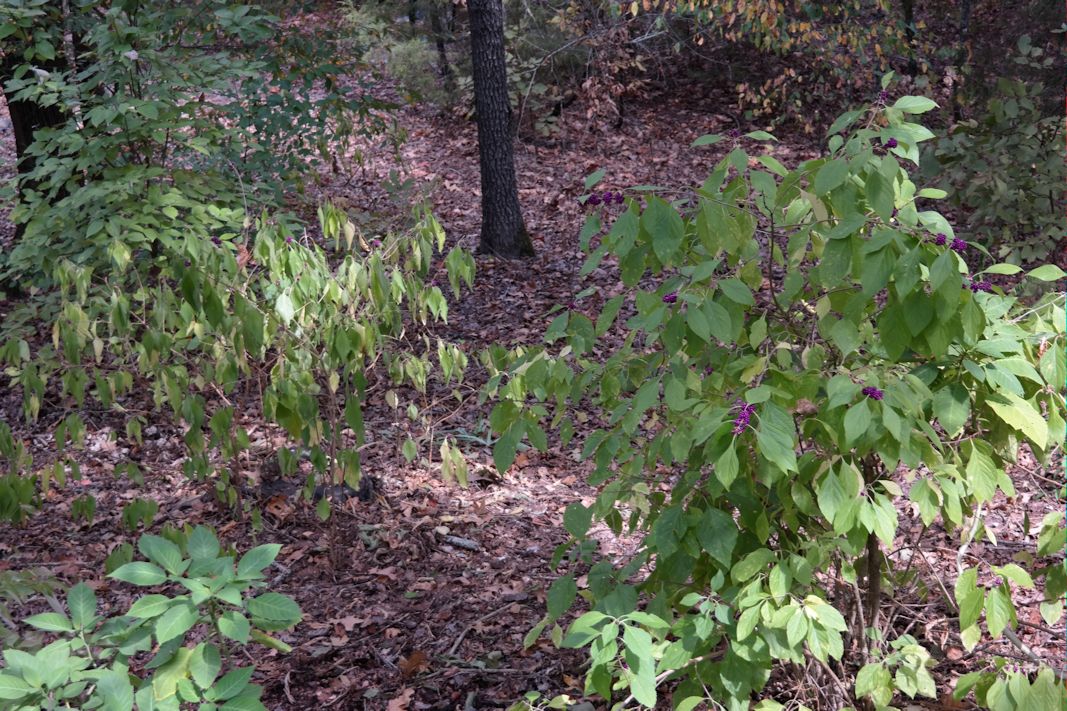
The left Beautyberry (aka: French Mulberry) below is outside of the sprinkler system which the one on the right is in. This picture was taken Sept. 30 after two months of heat and drought. In addition to the wilt on the left one, it also lacks the berries seen on the right one.
It's debatable whether more than a few of the plants below would be "drought tolerant" in Arkansas where summer-long drought is common,
I have spent many hours searching the Internet for the water needs of plants, often getting contradictory opinions and often not getting requirements which fit a specific category.
For example, FineGardening.com says that Goats Beard should be planted in "moist soil" but in a chart down the page from that statement, it says: "Moisture: dry to medium".
MissouriBotanicalGarden.org says "medium to wet" for Goats Beard. It also says "full sun to part shade" when most other sites say "part to full shade".
Early-blooming plants such as daffodils are a special case because they need water and sun during the winter and early spring. In central Arkansas, we normally get enough rain and snow during the non-summer months and when planted under deciduous trees, plenty of sun when the leaves are off the trees.
Most trees and shrubs are drought tolerant once established, but some, such as Japanese Maples, need frequent watering (according to online sources).
Prefer shade; do fine in partial shade:
Black Cohosh (shaded, partially shaded or even full sun)
Helleborus:
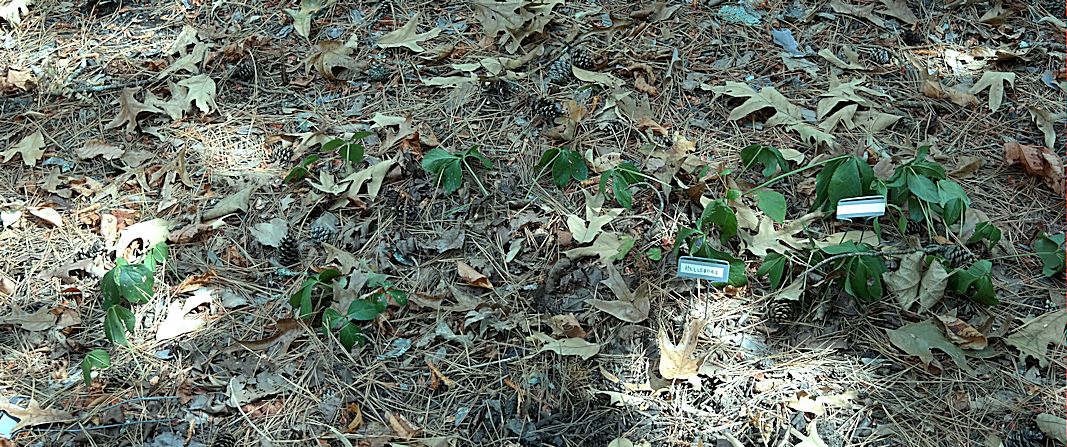
Prefers even moisture but can tolerate some drought.
This picture was also taken after two months of hot drought. Not bad for a plant which most sources say must be kept moist.
A single watering restored them.
Partial/dappled shade (some do well; others can do okay in shade but do better in sun):
Abelia
Barberry (shrub)
Black-eyed Susan
Blazing Star (Liatris spicata)
Butterfly Weed (Asclepias tuberosa)
Columbine
Coneflower, Purple (Echinacea purpurea; some sources say full sun)
Coreopsis, Lanceleaf (Coreopsis lanceolata; Jun-Jul; 18-24")
Cornflower
Daylily (Hemerocallis spp.; Jun-Jul; 12-48")
Festuca (blue-green grass 8-12"; flowers June.
Goat's Beard
Horsemint/Bee Balm/Monarda
Iris (only rebloomers should be watered during summer)
Lantana
Nandina (shrub)
Ox-Eye Daisy
Sedum (very drought tolerant)
Self-Heal / Heal-All
Penstemon (Beardtongue); mildly invasive via reseeding
Verbena/Vervain (some say full sun but we have had it in partial shade for many years)
Whirling butterflies (Gaura lindheimeri; Jul-Sep, 15-18")
Zebra Grass (and other ornamental grasses; Google specific species)
6+ hours sun (may need protection from afternoon sun in warm climates like Arkansas):
Bottle Brush
Crape Myrtle
Gaillardia; Jun-Aug; 18-24"
Lavender
Lewisia (evergreen; needs fast draining, sandy soil)
Oriental Poppy (Papaver orientale; very; May-Jun; 24-30")
Russian Sage
Zinnia
Deer Resistant, Dry Shade Plants:
Our property has no full sun and is frequently visited by deer. Since we already have a high water bill due to the landscaping in our main yard, I vowed to plant in the side lot only plants which are drought tolerant, and of course they also have to be able to do well in shade and to be unpalatable to deer.
While many sources list deer resistant plants and drought tolerant plants and shade tolerant plants, I've yet to see a list which combines all three traits. In addition, there is a lot of conflicting information on the Internet about these traits in different plants.
I have been trying plants in the side lot to see which survive. Visit our side lot pages to see what plants have worked.
Exceptions:
Spring-blooming plants such as daffodils which are often said to require full sun and moist soil may be planted under deciduous trees in Arkansas where they get sun before the trees leaf out and they usually get plenty of rain in the spring. They are deer resistant, so combining these things make them good for woodland gardens.
Reblooming irises need to be watered during the summer, but non-rebloomers do not. In fact, they should NOT be watered during the summer when they are dormant because it may cause them to rot. We are taught in Master Gardeners that irises need sun to bloom and that their rhizomes must be planted half above the ground and half in so that they get sun. Here is a picture of an iris growing in the shade with the rhizomes covered. Deer leave irises alone.

Deer Repellants
Daylilies can take partial shade and are drought tolerant, but deer love them. You can spray them with deer repellant or mix plants into the daylily bed which deer don't like to smell, such as allium and fritallaria. I have had great success with a product called Shotgun Repels All which is available at Lowes.
Strategies for Protecting Bulbs: The culprits: Squirrels, chipmunks, voles, deer, humans
Plant pest-resistant bulbs such as ‘Tommy’ crocus (Crocus tommasinianus), daffodils, hyacinths (Hyacinthus), fritillary (Fritillaria), grape-hyacinths (Muscari), snowdrops, and ornamental onions (Allium).
If planting just a few bulbs, build a mesh or wire cage to prevent them from being dug up or eaten by squirrels and voles. Use 1/2 hardware cloth for the bottom and sides of the cage and larger chicken wire for the top.
Add a handful of sharp grit to the holes when planting tulips and other bulbs to prevent voles from tunneling up.
Plant bulbs in large left-over plastic pots from plants purchased at a nursery. Add three inches of soil to the bottom of the pot, mix in fertilizer, sink the pot and bulbs into the ground just below soil level, and fill in. This will protect bulbs from voles and prevent you from slicing through them when digging in your perennial garden.
Cover newly planted beds with plastic bird netting, window screens, or hardware cloth to prevent squirrels and other animals from digging up newly planted bulbs. This is what we generally do at the Garden. Otherwise, spray the newly planted area with hot pepper sauce.
Plant bulbs that are susceptible to vole damage among patches of Narcissus. Voles hate daffodils and will stay away from the area.
Spray newly emerging shoots with deer repellent, hot pepper sauce, or surround the area with blood meal.
If you would like to expand your bulb collection, but end up destroying existing bulbs by slicing through them as you plant, here are a few helpful tips.
In the spring, when the bulbs are out, inter-plant them with summer-flowering bulbs like gladioli or annuals. At the end of the season, pull out the summer-flowering bulbs or annuals, and replant the holes with more spring bulbs.
Find creative ways of marking bulbs, so when the foliage disappears you know where they are planted. Suggestions include: golf tees, surrounding spring bulbs with fall-blooming crocuses, or marking the area with perennials. Fall bulbs include autumn-crocus (Colchicum), autumn-flowering crocus (Crocus speciosus), cyclamen (Cyclamen), snowdrops (Galanthus reginae-olgae), and nerine (Nerine).
Here's a list of critter-proof plants from DavesGarden.com. It shows Calla Lily as being zones 9-11, whereas we have calla lilies growing in our zone (7b), so don't take the zones as gospel.
Abyssinian Gladiolus/Sword Lily - Acidanthera murielae (Zones 7 to 11)
Astilbe/False Spirea (Zones 4 to 9)
Autumn Crocus - Colchicum spp. (Zones 4 to 8)
Begonia (Zone 10)
Black-eyed Susan - Rudbeckia (Zones 3 to 9)
Bleeding Hearts - Dicentra (Zones 3 to 9)
Bluebell or Hyacinth - Hyacinthus spp. (Zones 4 to 8)
Butterfly Plant - Buddleia (Zones 4 to 10)
Caladium (Zones 10 to 11)
Calla Lily (Zones 9 to 11)
Canna (Zones 7 to 11)
Climbing Lily - Gloriosa rothschildiana (Zones 7 to 11)
Common Snowdrop - Galanthus nivalis (Zones 3 to 8)
Coral Bells - Heuchera (Zones 4 to 8)
Crocosmia (Zones 5 to 8)
Crocus tommasinianus (Zones 3 to 8)
Crownvetch - Coronilla varia (Zones 3 to 9)
Daffodil - Narcissus spp. (Zones 4 to 11)
Cone Flower - Echinacea (Zones 3 to 8)
Elephant Ears - Colocasia (Zones 8 to 10)
English Lavender - Lavandula angustifolia (Zones 6 to 9)
Foxglove - Digitalis purpurea (Zones 4 to 9)
Foxtail Lilies - Eremurus (Zones 4 to 8)
Fritillary - Fritillaria spp. (Zones 4 to 8)
Gayfeather - Liatris (Zones 3 to 9)
Gentian - Gentiana makinoi (Zones 6 to 8)
Glory of the Snow - Chionodoxa spp. (Zones 4 to 8)Image
Grape Hyacinth - Muscari spp. (Zones 4 to 9)
Hardy Cyclamen - Cyclamen hederifolium (Zones 5 to 9)
Hardy Fern (Zones 3 to 8)
Hardy Fuchsia (Zones 8 to 10)
Hardy Geranium/Cranesbill (Zones 4 to 8)
Hardy Tall Phlox - Phlox paniculata (Zones 3 to 8)
Himalayan Lily - Cardiocrinum giganteum (Zones 7 to 10)
Honeysuckle - Lonicera 'serotina' (Zones 3 to 8)
Hydrangea (Zones 4 to 8 or 9/3 to 8)
Spring Star Flower - Ipheion spp. (Zones 4 to 9)
Larkspur - Delphinium (Zones 3 to 9)
Lily of the Valley (Zones 2 to 7)
Louisiana Iris (Zones 4 to 10)
Ornamental Onion - Allium spp. (Zones 4 to 8)
Peony - Paeonia (Zones 3 to 9)
Periwinkle - Vinca minor (Zones 4 to 9)
Prairie Mallow - Sidalcea (Zones 5 to 9)
Quamash - Camassia spp. (Zones 4 to 8)
Rock Soapwort - Saponaria ocymoides (Zones 3 to 9)
Russian Sage - Perovskia atriplicifolia (Zones 5 to 9)Image
Sage - Salvia (Zones 4 to 9)
Sambucus nigra (Zones 4 to 9)
Sea Holly - Eryngium (Zones 5 to 8)
Sedum (Zones 4 to 8)
Shamrock or Sorrel - Oxalis spp. (Zones 7 to 10)
Siberian Iris - Iris sibirica (Zones 3 to 9)
Snowflake - Leucojum spp. (Zones 4 to 8)
Spanish Bluebell - Hyacinthoides hispanica (Zones 4 to 10)
Squill - Scilla spp. (Zones 4 to 10)
Star-of-Bethlehem - Ornithogalum spp. (Zones 5 to 8)
Summer Tulip - Curcuma alismatifolia (Zones 7 to 9)
Thymus praecox (Zones 3 to 8)
Tritoma - Kniphofia (Zones 6 to 9 or 10 dep.reg.)
Trumpet Creeper - Campsis (Zones 6 to 10)
Verbascum (Zones 5 to 10)
Veronica (Zones 4 to 7)
Winter Aconite - Eranthis spp. (Zones 4 to 7)
|
Provide feedback
|